
Design knowledge library
Engineering Drawing and Metrology Library
This library helps engineers, buyers, and project teams navigate the decisions that make a drawing usable for manufacturing and inspection. Begin with the path closest to the current risk: unclear design intent, uncertain measurement requirements, or a formed sheet-metal feature that needs feasibility review. Each article is intended to support a more specific technical conversation.
01 / Reading path
Define Design Intent Clearly
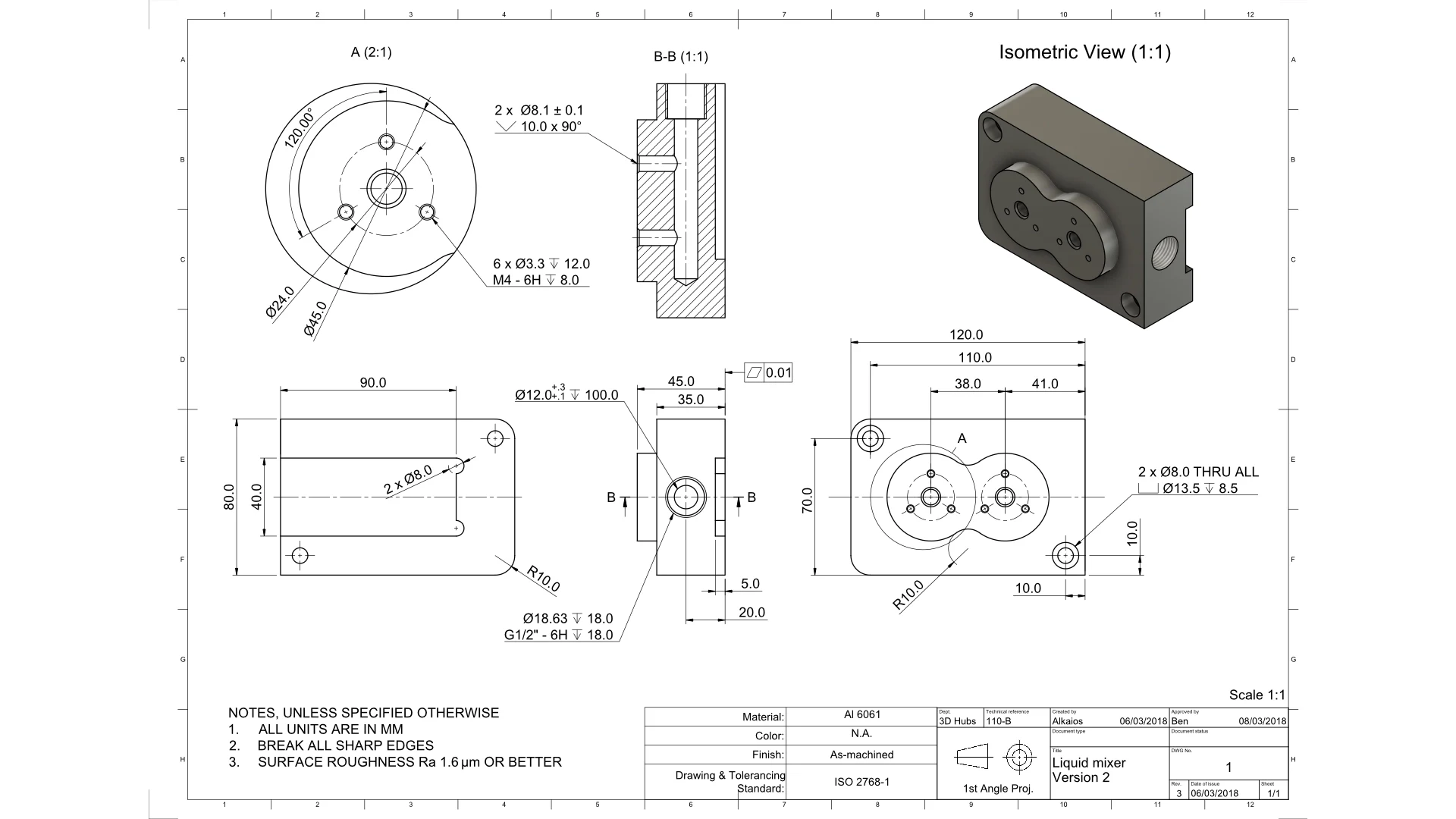
Choose this path when a part model exists but the manufacturing team, buyer, or quality reviewer still needs an unambiguous record of what controls the part. Start with articles on drawing structure, views, dimensions, hole and thread callouts, and notes. The key decision is which requirements must be explicitly communicated rather than inferred from geometry.
Read first when the release question is, “What must another team understand to make and inspect this part?” Establish functional dimensions, applicable standards, material grade, finish requirements, revision control, and any critical notes in the drawing package. Where requirements conflict or are incomplete, the approved drawing and engineering agreement control the answer.
02 / Reading path
Plan Measurement Around Function
Choose this path when the main decision is how a requirement can be evaluated consistently. Articles in this group connect dimensions and tolerances to datums, measurement access, inspection sequence, and reporting expectations. They are useful before assigning critical characteristics or reviewing an inspection approach.
Begin with the feature that carries the greatest assembly, sealing, motion, alignment, or safety consequence. Then ask what reference framework establishes its location and orientation, which measurement method is appropriate, and what evidence is needed. Do not assume a universal tolerance or measurement method; the drawing, applicable standard, material condition, and agreed process plan determine what is suitable.
03 / Reading path
Assess Formed Part Feasibility
Choose this path for sheet-metal parts whose geometry may depend on drawing depth, radii, material behavior, tooling direction, or defect risk. Start here when deciding whether a proposed form should move forward for process review, rather than when looking for general machining guidance.
Read the feasibility article first if the part includes deep drawn or highly formed features. Review geometry together with material grade, thickness, functional surfaces, toleranced features, and expected tooling approach. A successful route depends on the complete part definition and engineering review; design guidance identifies questions to resolve, not a substitute for a process-specific agreement.
Read this topic
Maximum Material Condition in Machined Part Inspection
Read the article →Engineering articleLeast Material Condition in Engineering Drawings
Read the article →Engineering articleBonus Tolerance Explained with a Worked Example
Read the article →Engineering articleComposite Position Tolerance for Hole Patterns
Read the article →Engineering articleTotal Runout vs Circular Runout
Read the article →Engineering articleCylindricity vs Circularity in Machined Bores
Read the article →Engineering articleSurface Texture Lay on Machined Parts
Read the article →Engineering articleRa vs Rz for Machined Surface Inspection
Read the article →Engineering articleBallooned Drawings for CNC Inspection
Read the article →Engineering article2D Drawing vs 3D Model Conflicts
Read the article →Engineering articleDatum Targets for Irregular Machined Parts
Read the article →Engineering articleGo No-Go Gauges vs Variable Measurement
Read the article →Turn the drawing into a clear manufacturing brief.
Share the current drawing, material, finish and inspection requirements for a project-specific discussion.