
Engineering article
How Raw Stock Size Affects CNC Part Cost
Raw stock size influences more than the material line on a CNC quotation. It affects whether suitable blanks are available, how much material becomes chips, the machining envelope, workholding approach, setup effort, and inspection planning. Designing from a realistic starting form helps teams distinguish necessary allowance from avoidable stock, document assumptions clearly, and compare alternatives before release.
On this page
Start With the Starting Form
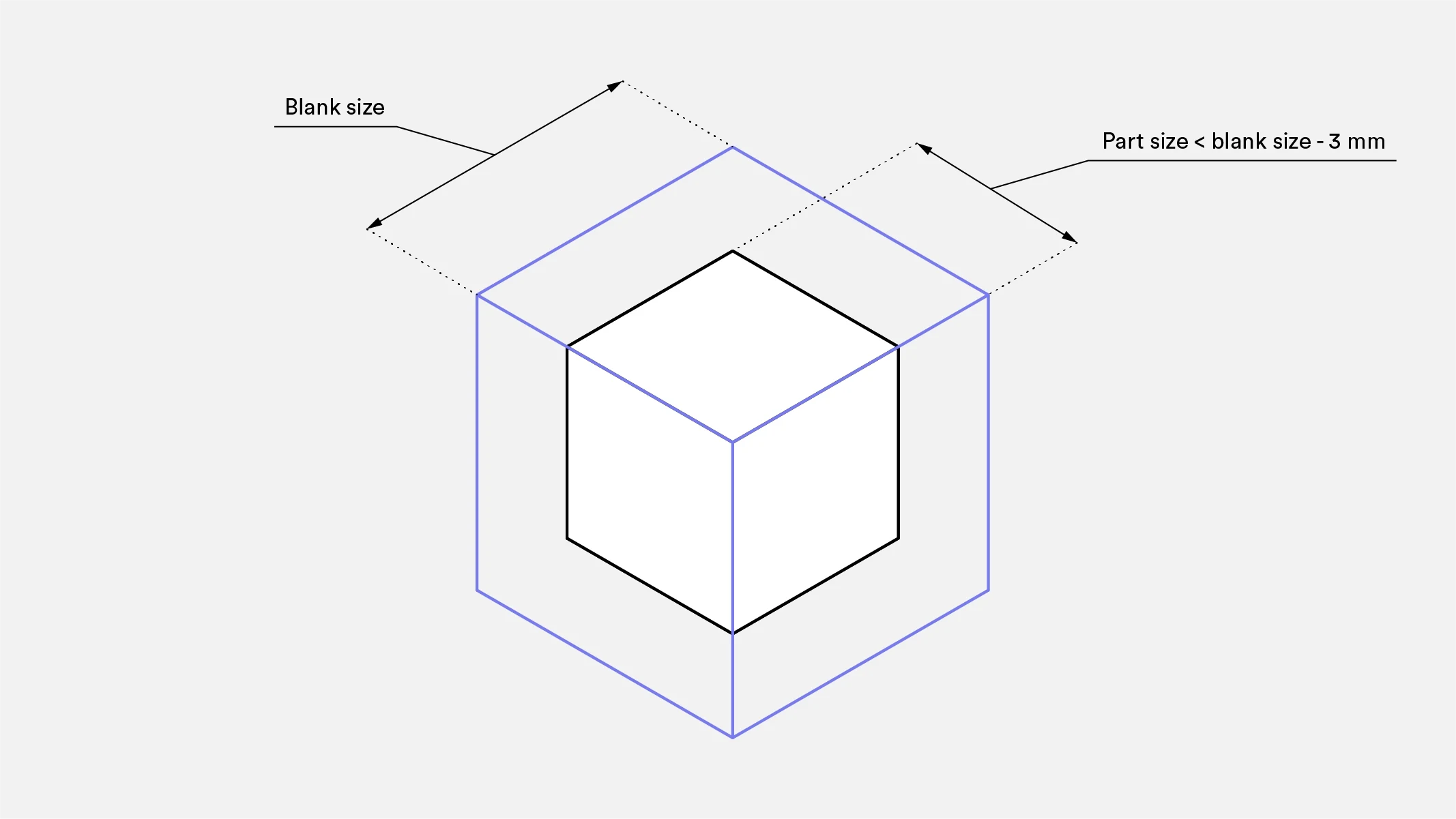
A finished part does not begin as its finished outside dimensions. It begins as a purchasable form such as bar, plate, tube, billet, casting, or forging. The gap between that starting form and the finished geometry establishes the material-removal task. A small change in finished length, wall arrangement, or overall envelope can move a component from a readily cut blank to a less convenient form, changing both waste and handling.
The most economical starting form is not automatically the one with the lowest price per kilogram. It is the form that gives the required material condition and enough stock for stable machining while avoiding unnecessary removal. The applicable drawing, material grade, and engineering agreement should define whether a specified form, grain direction, condition, or traceability requirement limits the choices.
- Identify the intended stock form before requesting a cost comparison.
- Separate finished dimensions from machining allowance on internal planning documents.
- Confirm whether the material specification permits alternative starting forms.
Blank Envelope Drives Material Yield
Material yield describes how effectively a blank becomes finished parts rather than offcuts and chips. A large rectangular blank around a compact profile may be easy to source, yet much of its volume may be removed. Conversely, a closer starting shape can reduce cutting but may carry additional procurement, preparation, or incoming-inspection considerations. Cost therefore follows the whole conversion path, not a single scrap percentage.
Saw-cut length, kerf, edge condition, and batch nesting also affect the usable blank envelope. These details are especially relevant when a part is long, thin, ring-shaped, or produced in multiple orientations. A quote should state any assumed blank dimensions where they materially affect cost, because a finished model alone may not reveal the intended stock utilization.
- Review part orientation on common stock dimensions.
- Consider offcut reuse only when material identity and segregation can be maintained.
- Ask whether multiple parts can be nested from one parent piece without compromising traceability.
| Starting-form option | Potential cost benefit | Planning question |
|---|---|---|
| Oversize bar or plate | Simple sourcing and generous clamping area | How much perimeter and thickness will be removed? |
| Closer-cut blank | Lower removal volume and less chip handling | Does preparation introduce added operations or variability? |
| Tube or hollow form | May avoid drilling away a central volume | Do wall tolerance, concentricity, and end access support the drawing? |
| Near-net formed blank | May reduce rough machining | Are material condition, machining allowance, and inspection expectations defined? |
Removal Volume Is Only One Variable
More removed material usually means more roughing passes, chip generation, and tool engagement, but removed volume does not scale cost by itself. A deep pocket, narrow cavity, or interrupted surface can take more time than a larger but open cut. Material machinability, tool reach, cutter diameter, and permitted cutting strategy influence the result. The process plan, rather than a universal removal-rate rule, determines the practical relationship.
Stock that is too close to finished size can also be problematic. It may leave insufficient material to clean up a surface, establish a datum, compensate for stock variation, or hold the part securely. The necessary allowance depends on the material form, required surfaces, geometry, and agreed process. It should be engineered deliberately instead of added uniformly to every face.
- Reserve allowance where surfaces must be machined, not automatically on every surface.
- Flag deep features whose cutter reach is influenced by the blank shape.
- Assess difficult geometry by access and engagement, not just removed volume.
Workholding Changes With Stock Size
Blank size affects how the part is held before it affects how it is cut. An oversize blank can provide useful sacrificial grip, but it can require heavier handling, a larger fixture, longer clamping, or an additional operation to remove the grip area. A compact blank may reduce material use yet leave too little secure contact area for an early machining stage.
The final workholding strategy should protect functional surfaces and provide repeatable datum transfer between operations. For example, a part that needs machining on several faces may benefit from planned locating features or sacrificial tabs, while a thin-walled part may need a sequence that preserves stiffness until late in the process. These choices belong in manufacturing review and should not be inferred solely from the nominal finished shape.
- Show surfaces that cannot accept clamp marks or temporary features.
- Define functional datums before choosing a blank orientation.
- Ask whether a grip feature must be removed in a later setup.
Machine Envelope and Setup Economics
A blank may fit within a machine envelope only after considering jaws, fixture elements, tool clearance, and required rotation. The relevant envelope is therefore larger than the finished component. Stock that forces a different machine class, a different orientation, or manual repositioning can change the cost structure even when the finished geometry is unchanged.
Setup effort is shared across the quantity produced. At low quantities, programming, first-part validation, blank preparation, and fixturing can dominate the unit cost. At higher quantities, repeatable cut blanks and dedicated holding methods may become more meaningful. Quantity does not eliminate the importance of raw stock; it changes which stock-related cost is most visible. The requested quantity and release pattern should be included with the quote package.
- Provide annual demand only if it reflects a real planning scenario.
- Distinguish prototype quantity from planned repeat quantity.
- Check the stock envelope with the proposed fixture and machining orientations.
Drawings Must Carry the Intent
A clear drawing prevents raw-stock decisions from becoming hidden assumptions. It should identify the material grade and condition, finished dimensions, tolerances, datum scheme, surface requirements, and any areas allowed to remain as-stock. If a particular starting form is mandatory, state it explicitly. If it is not mandatory, leave room for a manufacturing proposal while retaining the functional requirements that cannot change.
Inspection requirements are connected to blank strategy because datums must be established before results can be verified. A surface that remains as-stock may not support the same measurement approach as a machined datum. Likewise, profile, wall, or concentricity requirements can depend on the sequence used to locate the part. Define acceptance criteria through the drawing, applicable standard, and engineering agreement rather than relying on informal expectations.
- Mark as-stock surfaces and permitted cosmetic variation where relevant.
- Specify the datum reference frame used for critical relationships.
- Attach material, inspection, and revision documents to the quotation request.
Build a Better Pre-Quote Review
Before requesting pricing, compare the finished model with candidate blank forms and identify the largest removable zones. Then examine where material must remain temporarily for clamping, where tools need entry and exit room, and which surfaces establish inspection datums. This quick review often reveals whether a slightly different outside dimension, internal opening, or feature location would simplify the starting form without changing the part’s intended function.
A useful quotation request asks for assumptions to be visible. Request separate attention to material form, cut blank dimensions, preparation operations, machining setups, finish, and inspection where the project requires them. If several designs are under consideration, submit them as controlled alternatives with the same quantity and material basis. That makes the cost effect of stock selection easier to evaluate than a comparison assembled from unrelated quotes.
- Include controlled CAD and drawing revisions.
- State acceptable material-form alternatives and any prohibited substitutions.
- Request clarification of assumed blanks when stock is a meaningful cost driver.
- Review cost changes alongside risk to datum control, accessibility, and inspection.
Questions engineers ask
Does a larger blank always make a CNC part more expensive?
No. A larger blank can increase purchased material and removal work, but it may improve clamping, availability, or setup stability. The result depends on the material grade, geometry, quantity, machining plan, and drawing requirements.
Can a tube reduce CNC material cost?
It can reduce removable central material for suitable hollow parts, but tube wall variation, concentricity, available dimensions, end access, and the specified material condition must be evaluated against the drawing.
What should be supplied for a stock-sensitive quotation?
Provide controlled CAD and drawings, material grade and condition, quantity, required finish and inspection information, functional datums, restrictions on starting form, and any acceptable alternative blank forms.
References and further reading
These resources explain related design and manufacturing principles. Project limits, acceptance criteria and process choices must be agreed against the current drawing.
Publication note: this article is general design guidance, not a material specification, a certified inspection report or a guarantee of process capability.
Turn the drawing into a clear manufacturing brief.
Share the current drawing, material, finish and inspection requirements for a project-specific discussion.