
Engineering resource
Material Grade Cross-Reference Worksheet
A material grade cross-reference worksheet provides a controlled place to compare a specified material with a proposed alternative. It records the applicable drawing and standards, product form, material condition, supporting evidence, review decisions, and approval status. The worksheet supports traceable engineering review; it does not establish automatic equivalence, certify material, or replace inspection.
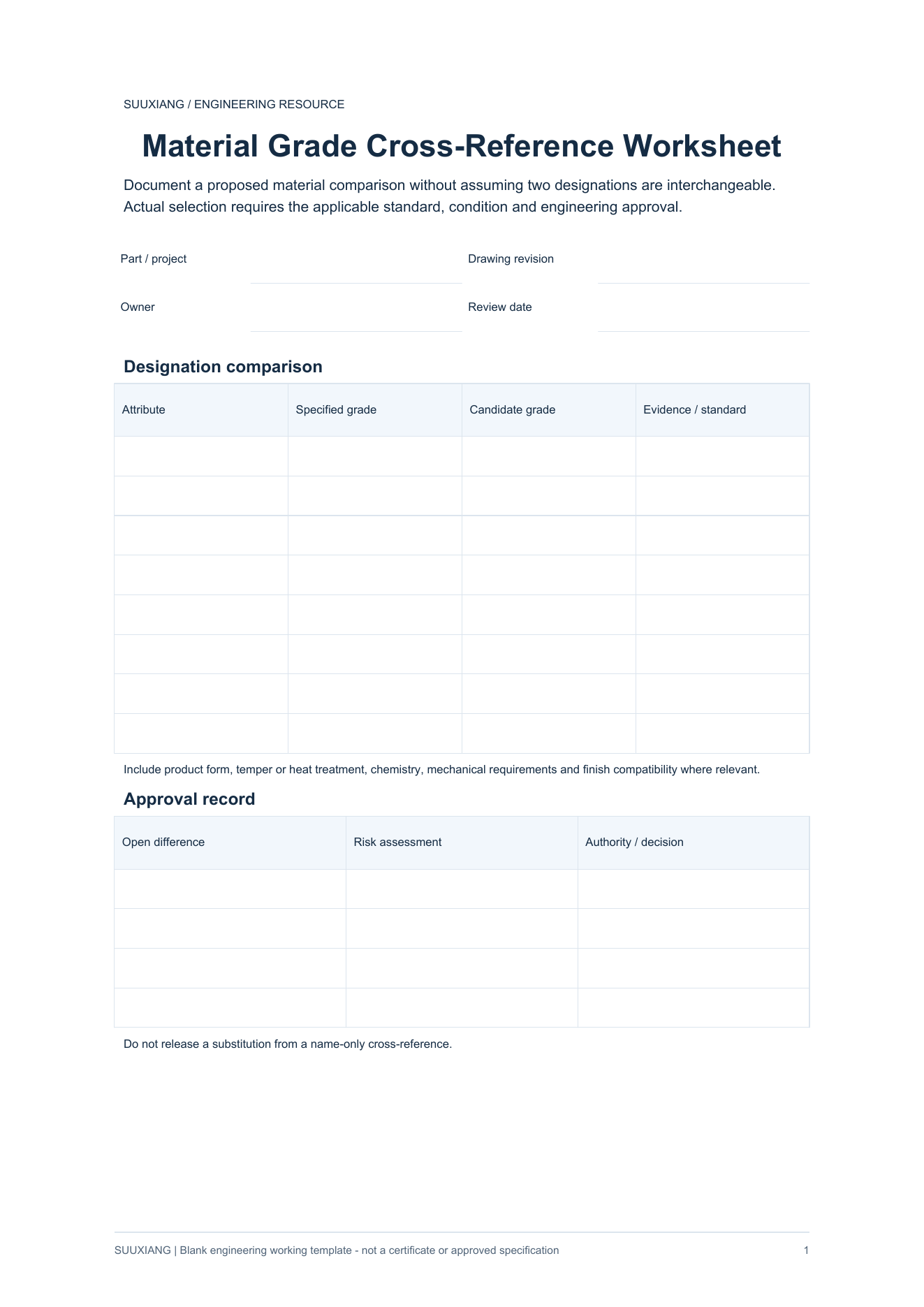
Download the blank working template
This editable-by-hand PDF is a blank engineering worksheet, not a completed inspection report, certificate, customer record or approved specification.
Download PDF template →On this page
What the blank worksheet captures
The blank PDF is a structured record for evaluating whether a proposed material designation may be considered against a specified designation. It captures part or project identification, drawing and revision references, the specified and proposed grades, governing standards, product form, condition, and the reason for review. It also provides space for technical comparisons, linked evidence, risk notes, disposition, and approval signatures or electronic approvals.
- Specified material designation and controlling document revision
- Proposed designation, supply form, condition, and applicable standard
- Comparison findings, open questions, restrictions, and approval status
Use it as a review record
Begin with the requirement, not a grade name alone. Enter the exact drawing callout, customer specification, internal standard, or approved process plan that controls the part. Identify the material product form because plate, bar, tube, casting, forging, and molded stock can be governed by different requirements. Record the supplied condition, such as annealed, heat treated, or other stated condition, where relevant to the controlled requirement.
Then compare only the characteristics necessary for the intended service and manufacturing route. These may include composition limits, mechanical-property requirements, corrosion environment, temperature exposure, cleanliness, traceability, joining compatibility, and downstream finishing. A similar designation can be unsuitable if form, condition, test basis, or service assumptions differ. State unresolved items explicitly rather than treating a partial comparison as confirmation.
- Use one worksheet for one clearly defined proposed substitution or comparison decision.
- Reference revisions and document identifiers so later reviewers can reconstruct the basis.
- Mark the decision as approved, conditionally approved, rejected, or pending according to the applicable control process.
Attach controlled supporting evidence
Attach or reference the records that support the decision. Suitable evidence may include the applicable material standards, controlled material specifications, supplier material documentation, test reports when required, approved deviation records, customer approvals, and relevant process qualifications. The attachment list should identify each document by title, revision, date, and controlled location. If a record is unavailable, record that gap and define the action needed before release.
Evidence must address the actual material offered and the actual requirement. A datasheet or generic comparison table may help frame questions, but it does not override a drawing, standard, material grade requirement, or engineering agreement. Where chemistry, properties, testing, traceability, or regulatory suitability matter, the controlling documents establish what must be reviewed and retained.
- List every attachment and its revision or issue date.
- Link any waiver, concession, or deviation to the affected requirement.
- Keep supplier claims separate from the internal technical disposition.
Route approval to accountable roles
The completed record should be reviewed and approved by the functions authorized in the applicable quality system or project agreement. This commonly includes the responsible engineering authority for technical suitability and quality authority for document control, verification requirements, and traceability implications. Purchasing or supplier quality may contribute supplier evidence and supply-chain context, while the customer or end-user approval route applies when the contract, drawing, or specification requires it.
Approval should identify the scope of the decision. For example, a conditional disposition may apply only to a named part number, revision, material form, supplier source, or process route. Record the approver, date, decision, and conditions. Do not use an unsigned or incomplete worksheet as permission to substitute material.
- Follow the defined approval matrix for the affected product or program.
- Escalate conflicts between evidence and the controlled requirement.
- Retain the approved record with the relevant quality or engineering documentation.
Understand the worksheet limits
This worksheet organizes a decision; it does not create the technical basis for one. It is not a material certificate, a certificate of conformance, a completed inspection record, a test report, or a substitute for receiving verification. It cannot establish that two grades are equivalent across all product forms, conditions, applications, or jurisdictions.
When the requirement is ambiguous, the correct action is to obtain clarification from the document owner or authorized engineering authority. When an application has elevated safety, regulatory, environmental, or performance consequences, use the additional review, validation, testing, and customer approval required by the governing documents. The drawing, standard, material grade requirement, process plan, and engineering agreement control the final answer.
- Do not infer blanket approval from a completed comparison.
- Do not reuse a prior disposition outside its recorded scope.
- Reassess the record when the requirement, source, form, condition, or process changes.
Questions engineers ask
Does this worksheet prove that two material grades are equivalent?
No. It records a part-specific review and its evidence. Equivalence, acceptance criteria, and any verification requirements are controlled by the applicable drawing, standard, material specification, process plan, and engineering agreement.
What should be done if supplier documentation uses a different designation?
Record both designations, identify the applicable standards, confirm the supplied form and condition, attach controlled documentation, and route the comparison for authorized engineering and quality review. Do not accept the difference as automatic equivalence.
References and further reading
These resources explain related design and manufacturing principles. Project limits, acceptance criteria and process choices must be agreed against the current drawing.
Publication note: this article is general design guidance, not a material specification, a certified inspection report or a guarantee of process capability.
Turn the drawing into a clear manufacturing brief.
Share the current drawing, material, finish and inspection requirements for a project-specific discussion.