
Engineering article
Cutting Fluid Choices for CNC Machining
Cutting-fluid selection is a process-engineering decision rather than a catalog preference. The right choice depends on workpiece material, operation severity, machine and filtration limits, downstream cleanliness, and documented safety requirements. This guide explains how to define those conditions on a drawing and in a request for quotation so that fluid choice supports a controlled machining plan.
On this page
Begin With the Machining Mechanism
Cutting fluid choices for CNC machining should begin with the contact conditions at the cutting edge. Some operations mainly need cooling to limit heat in the tool, workpiece, and chip. Others need boundary lubrication to reduce friction where the chip slides across the tool. Deep cavities, interrupted cuts, fine finishing, drilling, tapping, and broaching-like tool paths can place very different demands on a fluid even when the workpiece material is the same.
A useful first question is whether the process is heat-limited, friction-limited, chip-evacuation-limited, or contamination-limited. High-speed external milling may benefit primarily from directed cooling and chip removal. A thread-forming or tapping operation may depend more heavily on lubricity at low cutting speed. When one component includes both conditions, the process plan may need a qualified compromise, separate fluid application, or a controlled sequence rather than a single assumed answer.
- List each machining operation, not only the final part geometry.
- Identify locations where chips can pack, recut, or remain trapped.
- State whether the surface will be coated, welded, bonded, painted, assembled, or cleaned afterward.
Match the Fluid to Material Behavior
Material family is a starting point, but the specified grade, heat treatment, product form, and condition govern the final decision. Steels can require protection against both heat and oxidation, while stainless grades may challenge tools through work hardening and poor heat transfer. Aluminum alloys raise separate concerns around staining, residue, and compatibility with downstream finishing. Copper alloys, titanium alloys, nickel-based alloys, cast materials, and engineering polymers each call for an explicit review rather than a generic metalworking-fluid label.
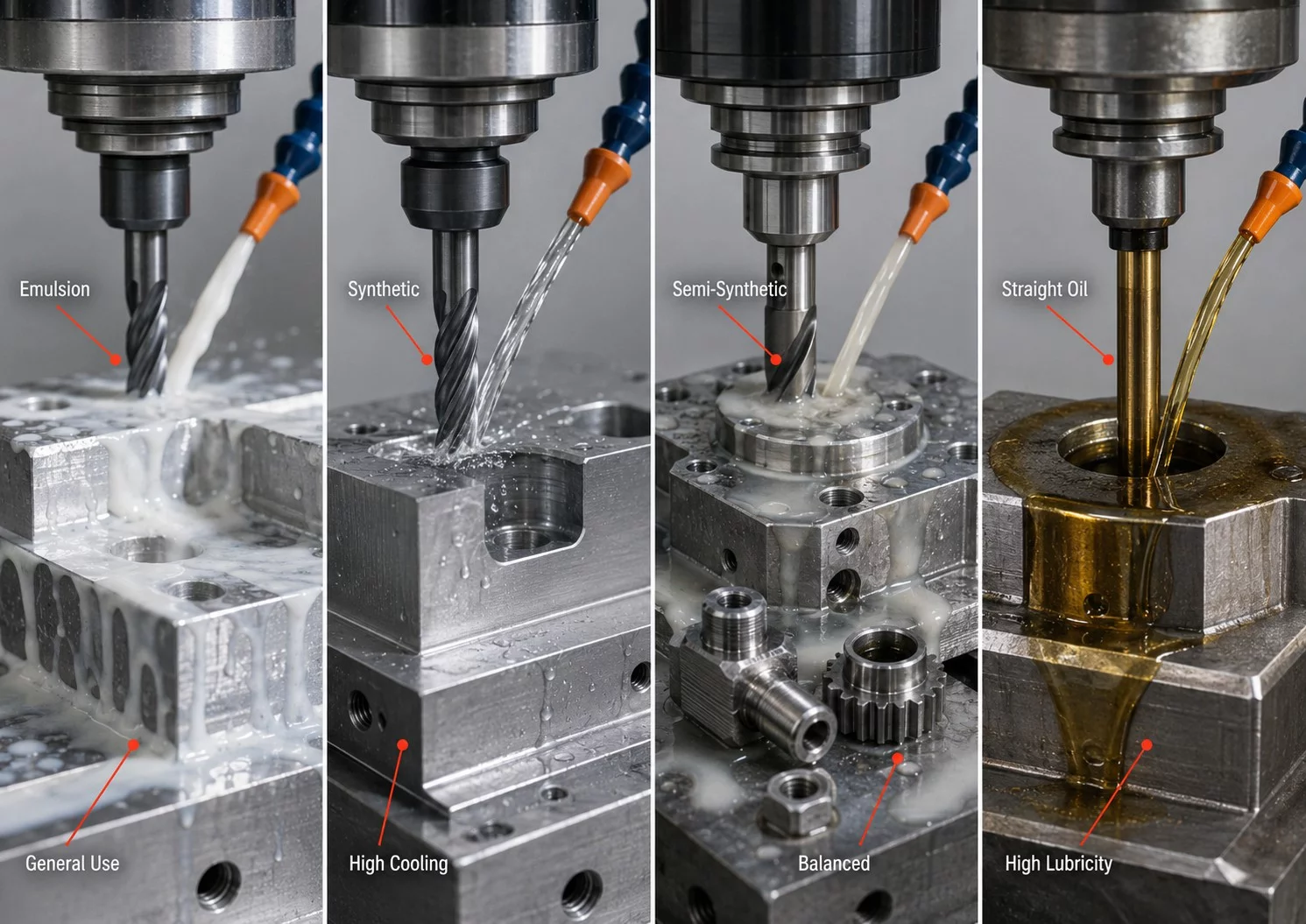
Water-miscible fluids can offer strong cooling and convenient washability when concentration, water quality, corrosion control, and maintenance are managed. Straight oils can provide high lubricity for demanding contact conditions, but may introduce mist, fire, cleaning, or residue considerations. Minimum-quantity application and dry cutting can be suitable for defined situations, yet they change chip transport, thermal behavior, enclosure housekeeping, and downstream cleaning requirements. Selection should be confirmed through the agreed process plan for the actual material and operation.
- Provide the exact material designation and condition on the request for quotation.
- Flag material combinations where cross-contamination or staining matters.
- Name restricted chemistries or residue limits when they arise from a standard, customer rule, or downstream process.
| Process condition | Fluid property to evaluate | Handoff question |
|---|---|---|
| High heat at the cutting zone | Cooling capacity and delivery reach | Can the tool interface receive controlled flow? |
| High sliding friction | Lubricity and film persistence | Does the operation include tapping, threading, or difficult chip formation? |
| Fine cosmetic surface | Residue, staining, and cleaning response | What surface condition is acceptable before inspection or finishing? |
| Deep or enclosed feature | Chip transport and filtration behavior | How will chips and fluid be removed from the feature? |
| Post-machining coating or bonding | Cleaning compatibility | Which cleaning and verification method is required? |
Consider Delivery Before Product Names
Fluid performance at the machine depends as much on delivery as on the formulation category. Flood flow, high-pressure through-tool delivery, external nozzles, mist, and near-dry application place coolant at different points in the cut. A fluid that is appropriate in a shallow open profile may not reach the active edge in a deep-hole cycle. Conversely, excessive flow can complicate small-part handling, encourage chip movement into sensitive areas, or obscure in-process observation.
Nozzle position, toolholder capability, spindle configuration, enclosure design, pump capacity, and filtration arrangement should therefore be reviewed with the planned tool path. This is especially important for blind holes, cross holes, narrow slots, thin walls, and parts with internal passages. The drawing should define functional geometry and acceptance requirements; the manufacturing plan should define the delivery method needed to meet them. Do not use a fluid choice alone as a substitute for access, fixturing, and chip-control planning.
- Ask whether coolant must pass through the tool or can be applied externally.
- Mark cavities that must be free of retained chips and fluid after machining.
- Review whether thin features can tolerate thermal and mechanical loading from the proposed cycle.
Build Safety Documentation Into Selection
Safety documentation is part of material and process compatibility, not an administrative task completed after a fluid is selected. The relevant documentation may include the safety data sheet, chemical inventory details, handling controls, disposal route, mist-management considerations, and any customer-specific substance declarations. Requirements differ by location, workplace program, finishing route, and contractual specification, so the applicable standard or agreement should control the requested evidence.
For a buyer or design engineer, the most valuable instruction is precise: identify prohibited or declarable substances, specify whether a current safety data sheet is required, and state any restrictions on odor, residue, cleaning media, or disposal handling that affect the production environment. Avoid treating broad labels such as non-toxic, environmentally friendly, or operator-safe as engineering acceptance criteria. They do not define exposure conditions, local obligations, compatibility, or documentation scope.
- Request documentation versions and review dates where contractually required.
- State whether a downstream process has chemical compatibility restrictions.
- Define the responsible party for waste, cleaning residue, and compliance records in the commercial agreement.
Protect Surface Integrity and Inspection
Fluid selection can influence more than tool life. Heat, lubricity, corrosion inhibition, entrained debris, and retained residue may affect burr formation, discoloration, stain risk, cleaning effort, and the repeatability of visual inspection. These effects are highly dependent on material, geometry, cutting parameters, storage interval, washing method, and handling. A final requirement such as clean, burr-free, or cosmetic must be translated into an inspection method and acceptance boundary rather than left as an informal expectation.
Inspection planning also needs a clear sequence. A dimensional result obtained immediately after machining can differ from one evaluated after washing, cooling, deburring, protective treatment, or a defined stabilization period. The governing drawing, measurement standard, and agreed inspection plan determine how the part is accepted. For critical fits or functional surfaces, indicate datum strategy, measurement method, surface-finish requirement where applicable, and whether the part must be dry or cleaned before inspection.
- Define cleanliness in observable terms: particles, visible residue, staining, or a named validation method.
- Identify dimensions sensitive to thermal state or post-process handling.
- Link cosmetic-surface requirements to packaging and inspection lighting if those are controlled by agreement.
Control Concentration, Cleanliness, and Change
A nominal fluid category does not ensure repeatable machining. Water-miscible systems vary with concentration, water chemistry, tramp-oil accumulation, microbial control, and replenishment practice. All systems can accumulate fines, degraded additives, and foreign materials. Filtration and tank housekeeping influence surface quality, tool contact, chip evacuation, and contamination risk. The operating window should come from the fluid supplier’s technical guidance and the qualified manufacturing process, not from a universal concentration rule.
Part changes require similar discipline. A change in alloy, plating allowance, tool coating, machining time, cleaning chemistry, or inspection requirement can make an existing fluid plan unsuitable. The production team should define what changes trigger review, which records are retained, and whether first-article or process revalidation is needed under the governing agreement. This approach makes fluid management traceable without implying that one setup is appropriate for every job.
- Ask how concentration or condition is checked and recorded for the planned process.
- Confirm filtration needs for the smallest passages and most sensitive finish areas.
- Establish a review trigger for material, chemistry, tool, or cleaning-process changes.
Prepare a Useful Quotation Package
A strong pre-quote package gives the manufacturer enough information to assess fluid compatibility without prescribing an unverified brand or recipe. Supply the latest controlled drawing, revision status, material grade and condition, expected quantity range, critical features, surface requirements, and all downstream operations. If the part contacts food, medical, optical, vacuum, electrical, coating, bonding, or corrosion-sensitive systems, state the applicable restrictions and the specification that creates them.
Then distinguish mandatory requirements from preferences. Mandatory items may include a prohibited substance list, documented cleaning requirement, no-residue acceptance condition, or customer-approved process record. Preferences may include a preferred fluid type or a desire to minimize a particular exposure. This distinction helps the quotation review focus on engineering risk, available controls, and documentation rather than unsupported assumptions. Any final fluid selection, inspection approach, and change-control method should be captured in the agreed manufacturing documentation.
- Attach the drawing, relevant standards, and material certificate requirement if applicable.
- List downstream finishing, cleaning, assembly, and packaging constraints.
- Ask for exceptions, assumptions, and proposed verification steps to be stated before order release.
- Record who approves process changes that could affect chemical compatibility or cleanliness.
Questions engineers ask
Should the drawing specify a particular cutting fluid?
Usually, specify the functional requirement instead: material compatibility, residue limits, prohibited substances, required documentation, and inspection condition. Name a particular fluid only when a controlling standard, validated process, or engineering agreement requires it. The manufacturer can then evaluate a suitable controlled process plan.
Is water-miscible fluid always safer or easier to clean than oil?
No. Water-miscible systems often provide useful cooling and washability, but their suitability depends on formulation, concentration, water quality, maintenance, corrosion behavior, cleaning method, and the applicable safety controls. Oil-based systems have different lubricity, mist, residue, and housekeeping considerations. Review the actual operation and documentation.
What should be confirmed before approving production?
Confirm the material grade and condition, operations, fluid-delivery approach, cleaning sequence, residue or chemical restrictions, inspection condition, and change-control responsibilities. The drawing and applicable standards define part acceptance; the agreed process documentation should define how fluid-related controls are managed.
References and further reading
These resources explain related design and manufacturing principles. Project limits, acceptance criteria and process choices must be agreed against the current drawing.
Publication note: this article is general design guidance, not a material specification, a certified inspection report or a guarantee of process capability.
Turn the drawing into a clear manufacturing brief.
Share the current drawing, material, finish and inspection requirements for a project-specific discussion.