
Engineering resource
CNC DFM Review Worksheet
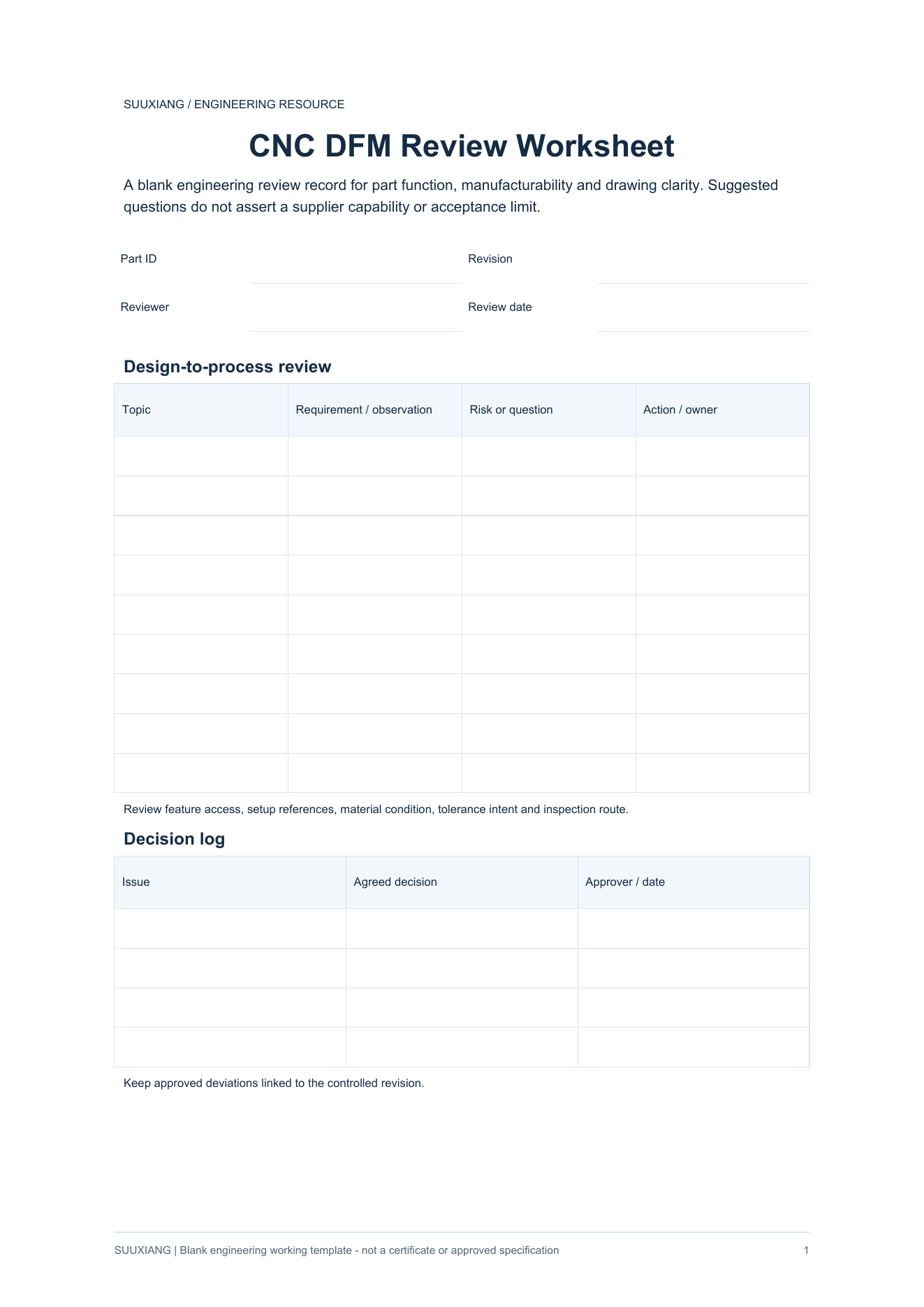
The CNC DFM Review Worksheet is a blank PDF used to organize a manufacturability discussion before production planning. It captures part requirements, potential machining concerns, evidence references, decisions, and ownership of follow-up actions. Use it alongside controlled drawings and specifications; it records a review, not a certification, inspection, or release decision.
Download the blank working template
This editable-by-hand PDF is a blank engineering worksheet, not a completed inspection report, certificate, customer record or approved specification.
Download PDF template →On this page
What the blank PDF captures
The worksheet provides a structured record for an early CNC design-for-manufacturability review. Complete the identification fields first: part name or number, drawing revision, requested material grade, relevant standards, intended process context, and review date. The review items then capture features that may need discussion, such as access for cutting tools, internal geometry, thin sections, datum strategy, toleranced features, surface requirements, thread details, and workholding considerations.
For every item, state the feature or requirement being reviewed, the potential manufacturing question, the agreed disposition, and any open action. Link the entry to a drawing zone, model view, specification clause, or controlled document where possible. The purpose is not to label a design acceptable or unacceptable in isolation. It is to make the assumptions, unresolved points, and engineering decisions visible to the people responsible for them.
How to complete the review
Use the worksheet during a focused review of the latest controlled design package. Read the drawing and model together when both are contractually applicable, then work feature by feature from critical interfaces to secondary details. Describe the condition precisely enough that another reviewer can locate it without reconstructing the conversation. If a concern depends on a material grade, machining sequence, inspection method, or mating-part condition, identify that dependency directly.
Use clear dispositions such as retain as specified, revise design, seek clarification, evaluate during process planning, or close with documented rationale. Avoid replacing a controlled requirement with a broad rule of thumb. A practical decision about radius, wall condition, tolerance, finish, or thread engagement depends on the drawing, applicable standard, material, process plan, and engineering agreement. Preserve open items until their evidence and approval are recorded.
- Confirm that the drawing revision and model status match the review record.
- Assign one accountable owner and a target decision point for each open item.
- Update the worksheet when a revision changes a reviewed feature.
Attach controlled supporting evidence
The completed worksheet should point to the evidence that supports its decisions. Attach or reference the controlled drawing and revision history, approved material specification, relevant customer or industry standards, model status, tolerance analysis where applicable, and any approved deviation or clarification. For feature-specific discussions, include marked-up views, datum schemes, interface definitions, thread callouts, finish requirements, or other records needed to understand the decision.
Where manufacturing feasibility requires additional evaluation, reference the approved process-planning record, tooling or workholding assessment, measurement strategy, or engineering communication that governs the next step. Do not use the worksheet as a substitute for those records. Its value comes from connecting the review discussion to the documents that control design intent, production planning, and verification.
| Evidence type | Why it matters |
|---|---|
| Controlled drawing and revision | Defines the reviewed requirement set. |
| Material and standard references | Clarify applicable design and material conditions. |
| Marked-up feature evidence | Makes the reviewed location and decision traceable. |
| Approved follow-up record | Documents how open issues are resolved. |
Approval and record ownership
Approval should follow the project’s documented responsibility matrix. In many workflows, the design authority confirms that the recorded interpretation preserves design intent, while a manufacturing or process-planning representative confirms that the review inputs are suitable for further planning. Quality, purchasing, project leadership, or the customer may also require review when their controlled process assigns them that role. Names, functions, dates, and revision status should be recorded on the completed document.
Approval of a DFM review is limited to the scope stated in the record. It does not replace drawing approval, material approval, process validation, first article activity, inspection acceptance, or contractual release. When a decision changes a controlled requirement, route that change through the applicable engineering-change or deviation process rather than treating a worksheet note as authorization.
Know the worksheet limits
A blank worksheet is a planning aid. It cannot demonstrate that a part has been machined, measured, inspected, or accepted. Likewise, a completed worksheet records the information available at the time of review; it does not guarantee machining outcomes, conformance, cost, schedule, or performance. Conditions can change when the design revision, material availability, process plan, measurement approach, or approved requirements change.
Use the record to improve the quality of questions asked before production decisions are made. Reopen the review when a change affects a critical feature, interface, tolerance, material requirement, or governing standard. Retain the completed version with its referenced evidence according to the project’s document-control practice so later reviewers can distinguish an early DFM discussion from approved production and inspection records.
Questions engineers ask
Is a completed CNC DFM Review Worksheet a certificate or inspection record?
No. It is a documented manufacturability review. It does not certify a part, replace inspection results, or establish product acceptance. Inspection and acceptance require the records and approvals defined by the applicable drawing, quality plan, standard, and engineering agreement.
When should the worksheet be revised?
Revise or reopen it when the controlled design package changes in a way that affects reviewed assumptions or decisions. Typical triggers include a new drawing revision, changed material grade, altered tolerance or datum structure, revised interface, updated standard, or a new process-planning constraint.
References and further reading
These resources explain related design and manufacturing principles. Project limits, acceptance criteria and process choices must be agreed against the current drawing.
Publication note: this article is general design guidance, not a material specification, a certified inspection report or a guarantee of process capability.
Turn the drawing into a clear manufacturing brief.
Share the current drawing, material, finish and inspection requirements for a project-specific discussion.