
Design knowledge library
CNC Cost and Procurement Library
This library helps engineering and procurement teams move from a specific buying decision to the most useful CNC reading path. Start with the question that is currently delaying release, quotation review, or supplier selection. The articles focus on cost drivers, sourcing risk, and downstream requirements rather than providing a general CNC overview.
01 / Reading path
Estimate the part cost
Choose this path when a quotation seems difficult to explain, a design team needs an early budget range, or a buyer must identify the main cost levers before requesting revisions. Start with the article on turning cost structure if the part is primarily rotational. It frames machine time, material use, setup activity, and tooling demand as separate estimating inputs, helping readers ask better questions about the process plan.
Then examine the design details that influence those inputs: stock form, feature access, tolerance scheme, batch size, and inspection expectations. No single design change has a universal financial outcome. The released drawing, selected material grade, required standard, and supplier’s proposed process plan determine whether a simplification is appropriate.
02 / Reading path
Compare procurement choices
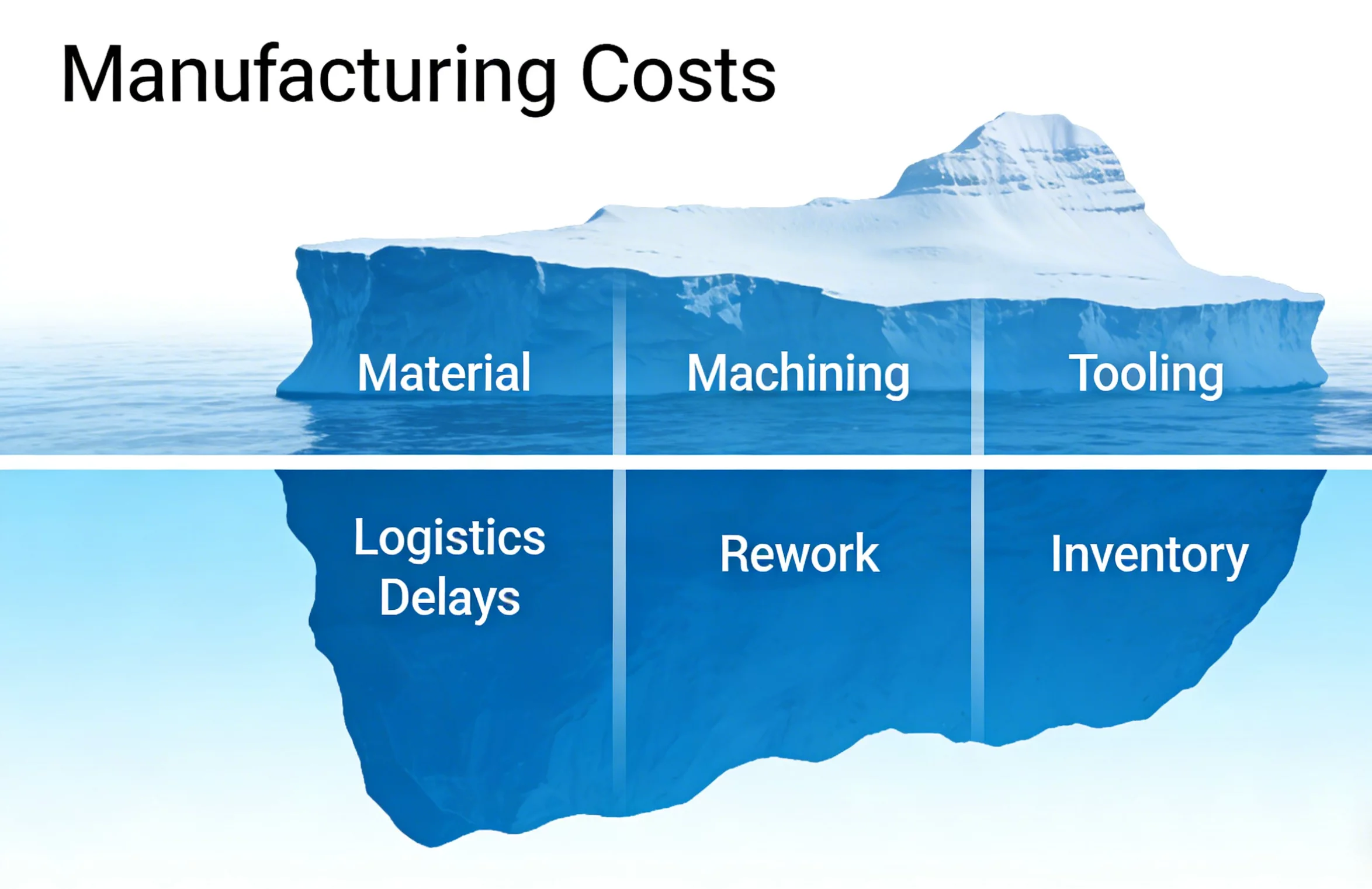
Choose this path when the lowest quoted price is not automatically the preferred purchase decision. Begin with total-cost thinking: evaluate costs that arise across specification, supplier coordination, production, receipt, inspection, rework handling, and continuity of supply. This approach gives procurement a practical structure for comparing offers that differ in more than unit price.
The first article in this path is useful before awarding work, especially when requirements are incomplete or cross-functional handoffs are likely. Record the assumptions behind each quotation and distinguish confirmed requirements from open questions. Commercial terms and engineering agreements should define responsibilities, acceptance criteria, documentation, and change handling for the specific purchase.
03 / Reading path
Plan finishing requirements
Choose this path when a machined part also needs deburring, surface treatment, marking, cleaning, assembly preparation, or another downstream operation. Start with the post-processing article to understand why an added operation can affect routing, handling, inspection, scheduling, and quotation scope. It is most valuable when the finish is important to function, appearance, corrosion behavior, or a mating interface.
Before requesting prices, define the finish on the drawing or referenced standard where applicable, including areas to mask, cosmetic surfaces, measurement points, and acceptance method. Avoid treating finishing as a late purchasing add-on. Reviewing it with geometry and material selection early helps the team identify dependencies that must be reflected in the process plan.
Read this topic
How Setup Count Affects CNC Machining Cost
Read the article →Engineering articleHow Raw Stock Size Affects CNC Part Cost
Read the article →Engineering articleHow Hole Depth Affects CNC Machining Cost
Read the article →Engineering articleHow Thread Specifications Affect CNC Quote Scope
Read the article →Engineering articleHow Inspection Scope Changes a CNC Quotation
Read the article →Engineering articleComparing CNC Quotes with Different Assumptions
Read the article →Engineering articleShould-Cost Breakdown for a CNC Part
Read the article →Engineering articlePrototype Approval Before Repeat CNC Orders
Read the article →Engineering articleEngineering Change Control for Machined Parts
Read the article →Engineering articleManaging Drawing Revisions Across CNC Suppliers
Read the article →Engineering articleMachining Allowance for Customer-Supplied Material
Read the article →Engineering articleOrdering Matched Machined Component Sets
Read the article →Turn the drawing into a clear manufacturing brief.
Share the current drawing, material, finish and inspection requirements for a project-specific discussion.